
Starting a West Seneca Resident Search
A West Seneca residents directory is a set of separate trails, not one master roster. For a current property question, begin with Erie County’s tax and parcel information. It identifies the parcel and assessed owner, but an owner’s mailing address can differ from the property address, and an owner is not automatically every person who stays there. For a historical household, begin with the right library volume and year. For a court, vital, or estate question, use the custodian that created that record. A name match is only a lead until a second fact, such as an address, legal description, time period, spouse, or case number, supports it.
West Seneca records are split between Town Hall, Erie County offices in Buffalo, New York State systems, and the Buffalo & Erie County Public Library. That division helps explain why a municipal FOIL request cannot replace a County Clerk deed search, and why a vital certificate is not an open name-search record. A precise question makes the search faster and avoids drawing a conclusion that the record does not support.
- For a known West Seneca address, use the Erie County property entry point to obtain the parcel or SBL reference.
- Move a recorded-ownership question to the Erie County Clerk BrowserView index, using party, town, instrument, Book/Page, parcel, or legal-description routes.
- For a dated household, ask the Grosvenor Room for the appropriate West Seneca, suburban, Haines, or historical directory.
- Use court and vital-record channels only for the record type at issue, then confirm details with the named clerk or registrar.
- When an agency-held Town record is not online, send a focused request through the Town’s FOIL route, naming the address, period, and record class.
Note: A lawful West Seneca search treats a missing result as an unanswered question, not proof that a person has no connection to a place.
West Seneca Resident Records Desks
Town material begins locally. The West Seneca Town Clerk is the Records Access Officer and a practical contact for Town-created records, licenses, archival material, and events kept by the local registrar. Parcel, tax, and deed work moves to Erie County. The County Clerk’s Registrar Division keeps land and title records, while Real Property Tax Services and the GIS provide the parcel layer. Election registration is a separate state and county-administered system. The West Seneca Streets page follows the address route in fuller detail.
Erie Real Property Tax Services
County parcel and tax assistance
716-858-8333
West Seneca Parcel Record Clues
Erie County’s parcel systems separate a property’s situs address from the assessed owner’s mailing address. The address is where the parcel sits. The mailing field is where the assessment notice goes. The durable bridge is the parcel identifier: Erie’s PIN includes a county SWIS code plus section, block, and lot, while the SBL is the section-block-lot portion. Once an address search supplies an SBL, it can connect the tax record, map, and recorded document trail. The parcel data can also carry a local ZIP, deed date, Book/Page, values, and building attributes, although not every field is populated for every parcel.
The Erie County Tax Inquiry landing page points to parcel search and tax functions. It is a current assessment clue, not a guarantee of title or occupancy.
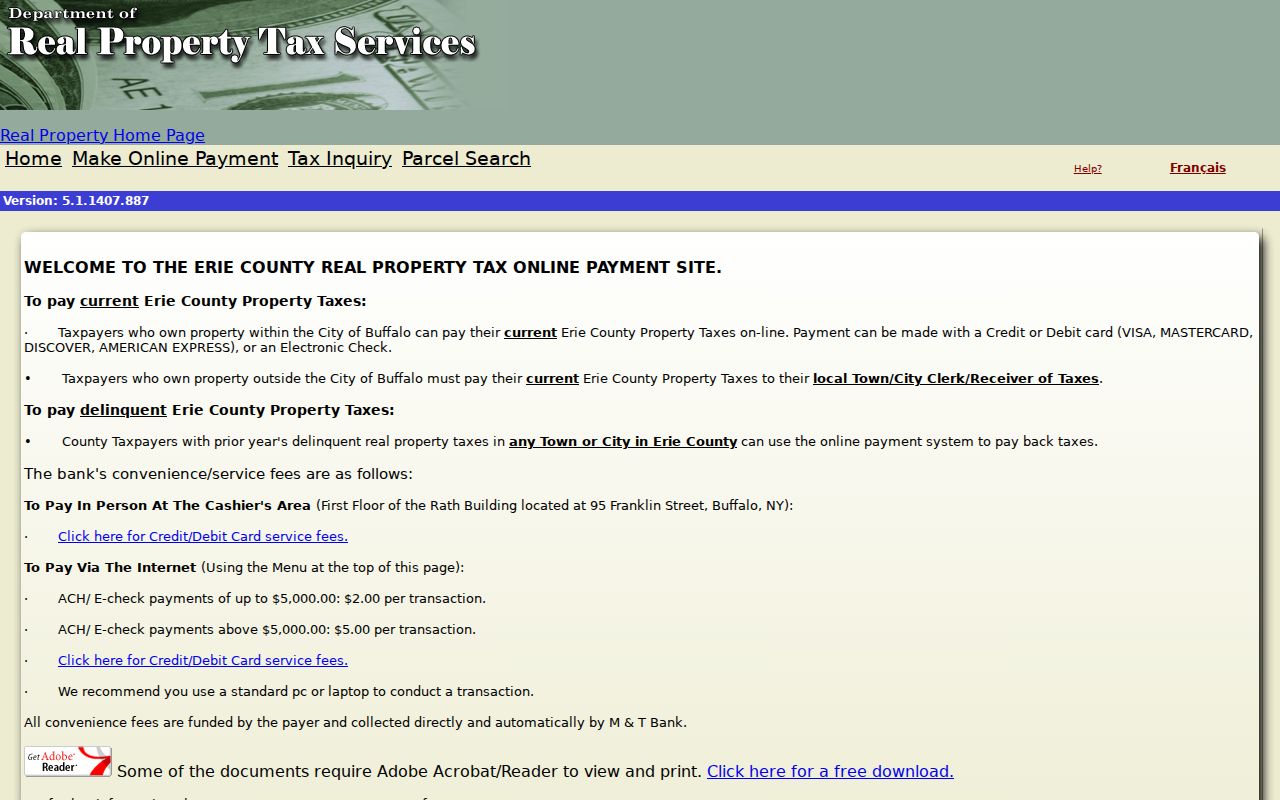
Starting with a public parcel narrows a West Seneca residents search to one defined property before a researcher turns to recorded documents or historical material.
| Parcel field | How it helps | Important limit |
|---|---|---|
| PIN or SBL | Bridges map, roll, and legal description | Keep zeros and separators as the system expects. |
| Situs address | Locates the parcel in West Seneca | It is not the deed’s legal description. |
| Owner and mailing data | Identifies assessed ownership and correspondence | It does not establish every occupant. |
| Deed date or Book/Page | Supplies a lead for BrowserView | Recent parcel fields do not complete an older title chain. |
BrowserView is the official next stop once a parcel supplies a Book/Page, file, party, or legal-description bridge. The Clerk’s index is not an ordinary street-address search, which is why moving directly from an address to a deed search can fail.
The Erie County Clerk’s Official Records Public Search shows the recorded-document search choices.
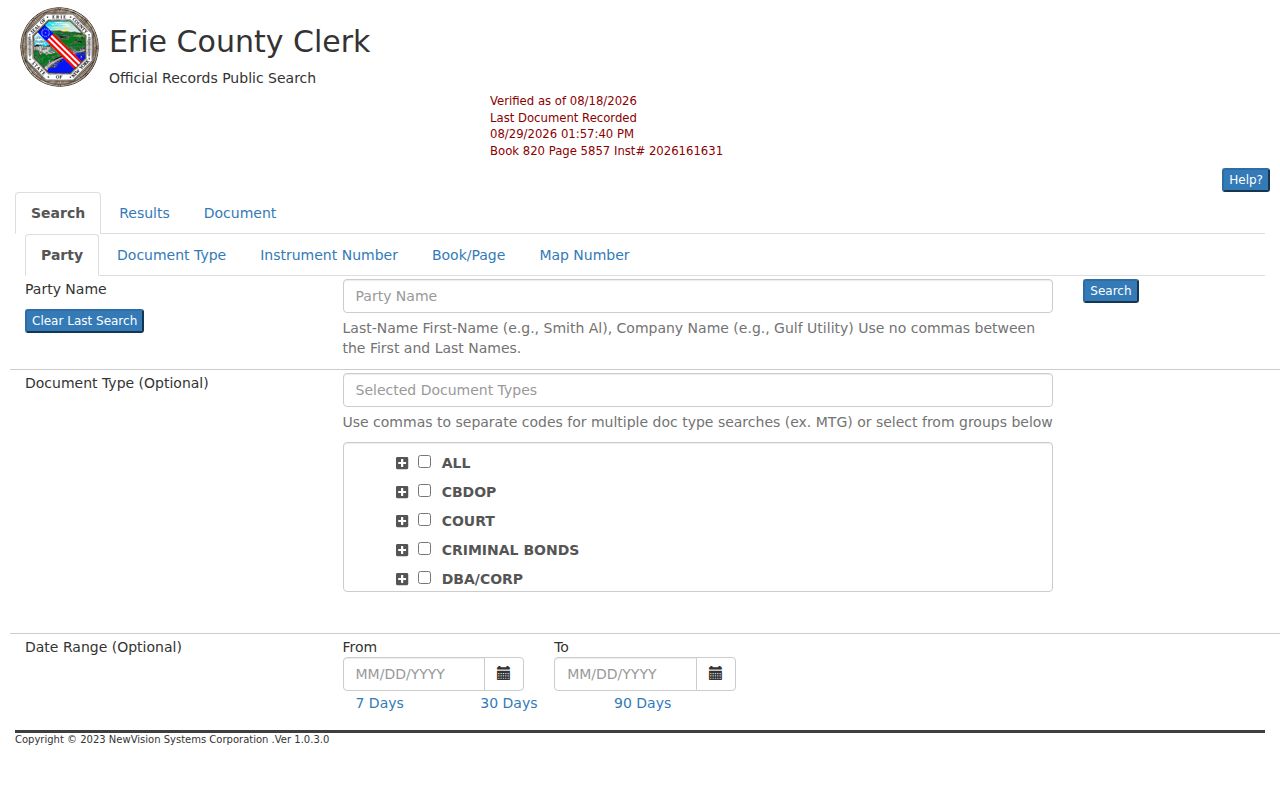
For a West Seneca parcel, the deed index can turn the property clue into a recorded party and legal-description trail without claiming that a deed party currently lives there.
Current West Seneca Resident Sources
Current West Seneca resident sources have different subjects. A parcel roll concerns assessed ownership. A deed index concerns parties to a recorded instrument. A court tool concerns a covered case. The voter tool is a registrant’s self-service status check, not a public street roster. Each is valuable when matched to its own question. Treating all of them as one people list would erase the access limits that the custodians and New York law impose.
| West Seneca source | What it can confirm | Custodian | Access path |
|---|---|---|---|
| Tax roll and GIS | Assessed owner, parcel, situs, selected transfer facts | Erie County | Public property and mapping tools |
| Official Records Public Search | Party, document, date, legal-description trail | Erie County Clerk | Public index, counter or request for records |
| NYS VoterLookup | A registrant’s own status, poll site, and ballot information | New York State | Self-lookup with identifying information |
| Grosvenor Room volumes | Historical listings tied to a particular year and edition | B&ECPL | Reading room, catalog, or research service |
| West Seneca library yearbooks | Named school-year entries in held volumes | West Seneca Public Library | In-library collection; confirm a volume first |
When the goal is to verify a particular person rather than explore an address or a year, the West Seneca resident lookup route explains how to compare independent records without turning a single hit into a conclusion.
West Seneca Voter Status Limits
NYS VoterLookup is for a registered New Yorker to check that person’s own registration, polling place, and ballot tracker information. The form requires last name, first name, date of birth, county, and address information. It is not a West Seneca residents directory by street. New York Election Law §3-103(5) limits use of voter-registration data to an elections purpose, and a county request has its own stated purpose and access rules. Ballot choices are not part of a voter record.
The NYS VoterLookup screen illustrates the self-service format.
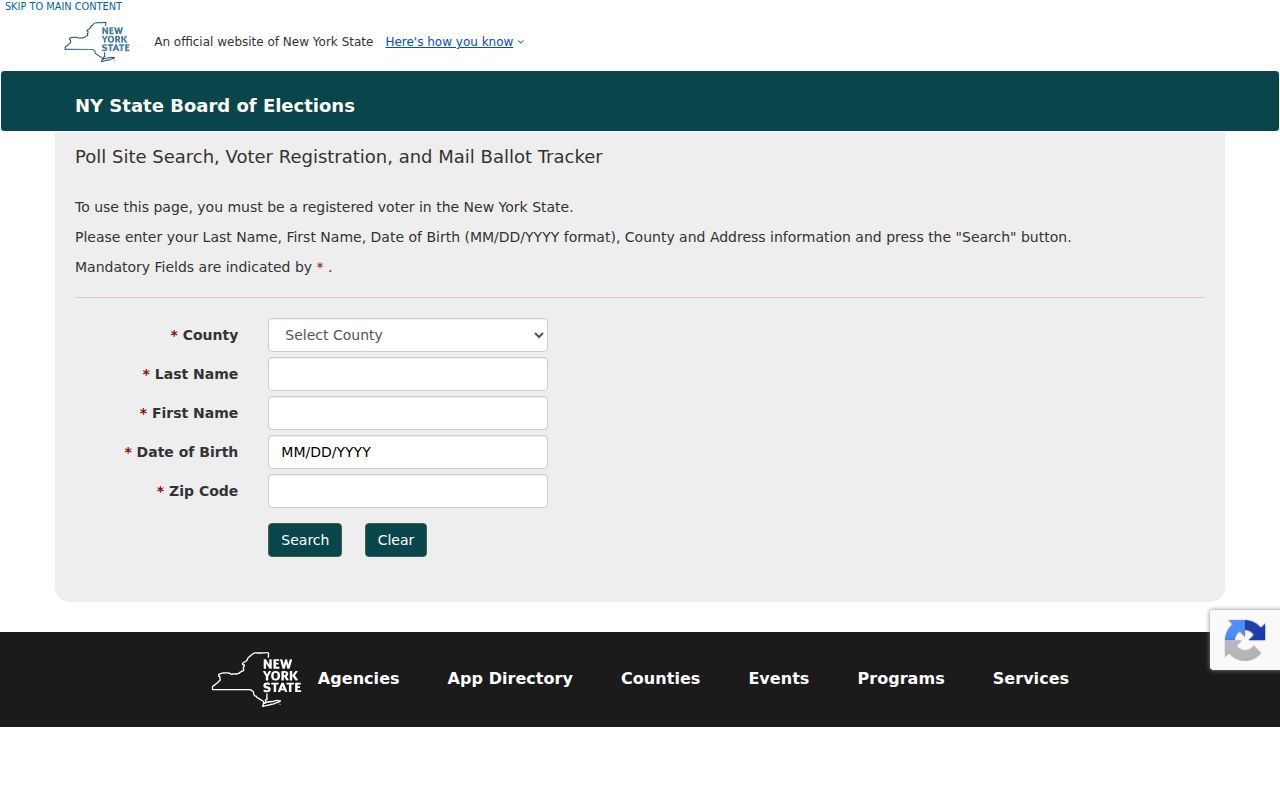
A West Seneca result from that tool should be understood as the registrant’s own status check, not as permission to build a current address list.
West Seneca Court and Vital Trails
Court records can corroborate a covered case, not prove current residence. WebCivil Supreme offers party, index, attorney or firm, justice, calendar, and document routes for Civil Supreme Courts. WebCriminal accepts a first and last name or corporation name and can be narrowed by court. West Seneca Town Court, Supreme and County Court, and Surrogate’s Court have distinct jurisdiction and clerk paths. Sealed, juvenile, family, and other protected matters remain outside ordinary public searching.
Vital records are different again. The Town Clerk is the local registrar for qualifying Town events; the New York State Department of Health is the state route for births, deaths, marriages outside New York City from 1881 and divorce certificates. Public Health Law §4174 restricts certified birth and death records, and certified vital records are not available through FOIL. Eligibility, event location, identification, and the document type decide the route.
- Index
- A finding tool that identifies a record or party. It is not necessarily the document image.
- Docket
- The court’s case listing or record of filings and events for a particular matter.
- Certified copy
- A copy issued and authenticated by the custodian when the requester qualifies under that record system’s rules.
- Legal description
- The land description in a recorded instrument, often more stable than a street address.
West Seneca Records Requests Under FOIL
For Town-created records that are not already published, use the West Seneca FOIL process or its online form. A focused request identifies the department, address or subject, date range, record category, and whether inspection or copies are wanted. The Town form does not maintain police or court records, so those requests belong with the proper police-records unit or court clerk. Code Enforcement material is a useful example: a request can specify a work address, time span, permit number if known, and the files sought.
The Town FOIL form provides an inspection-or-copy choice and a narrative field.
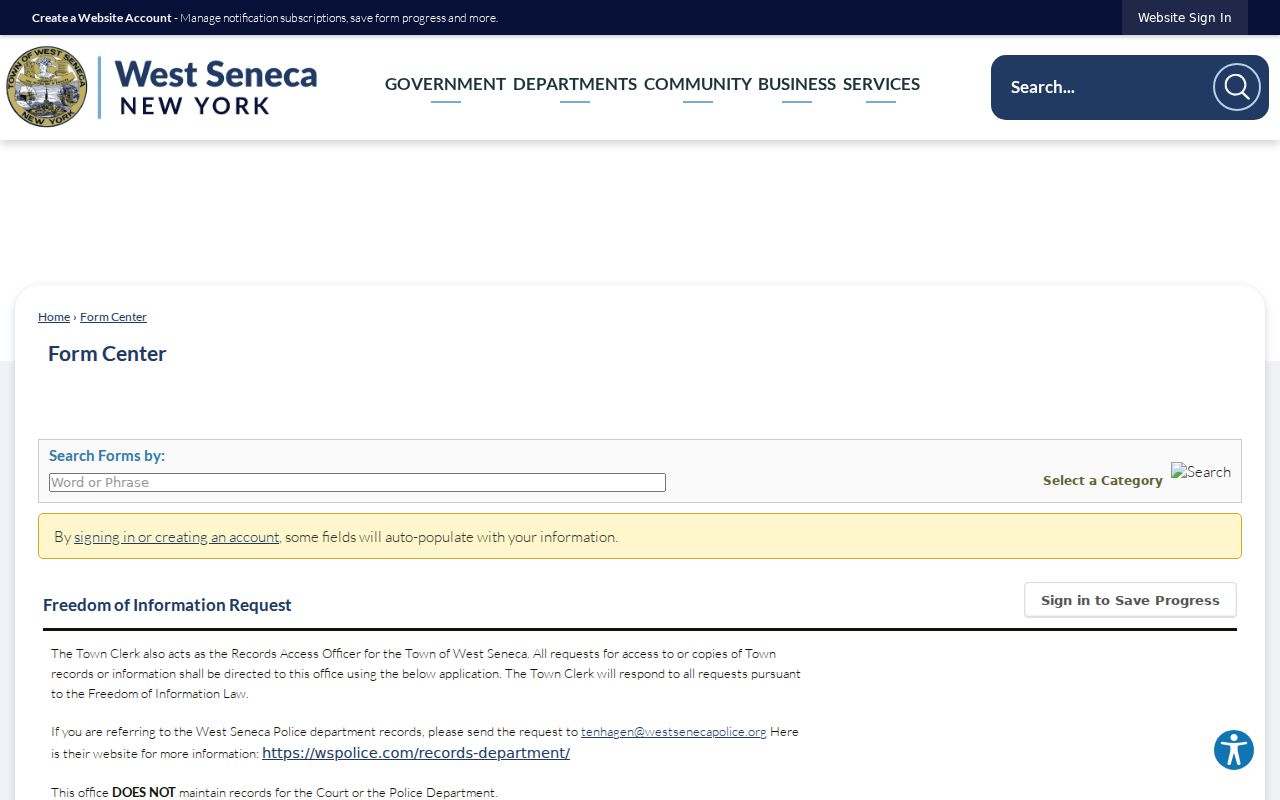
Under Public Officers Law §89(3)(a), an agency generally responds within five business days by granting, denying, saying it lacks the record, or acknowledging the request with an approximate date. That is a response rule, not a promise that a long historical search will finish in five days.
West Seneca Historical People Sources
Historical resident research needs the correct geography and volume. B&ECPL’s Grosvenor Room holds Buffalo City Directories from 1828 forward, with listed gaps, but suburban Erie County towns were published separately and most began in the 1950s. The collection guide identifies Erie County Suburban, Southeast Suburban, Buffalo Suburban, Buffalo South Suburban, and Haines directories that are more useful for many West Seneca searches. The digitized Buffalo City Directories collection contains 77 objects dated 1832 to 1913, yet Buffalo coverage should never be assumed to include every West Seneca household.
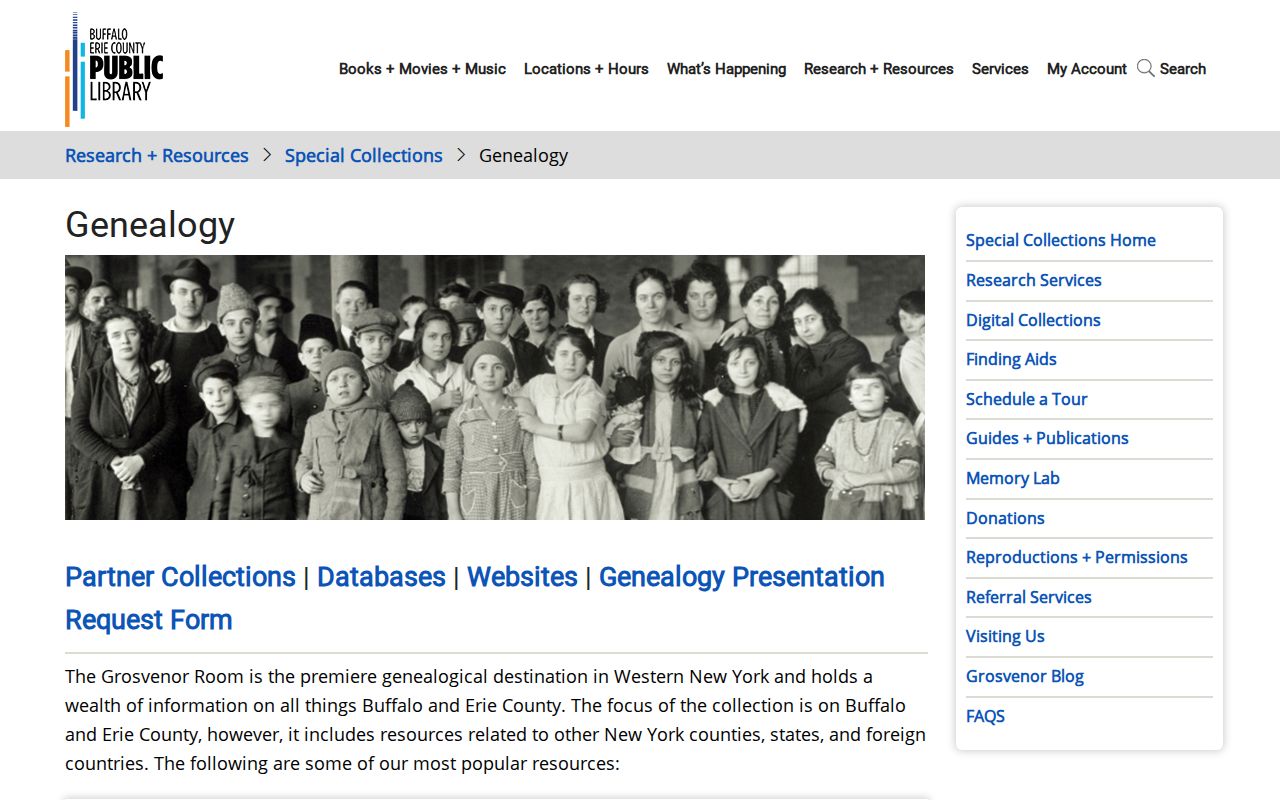
The Grosvenor Room genealogy collection brings directories together with census access, newspapers, maps, yearbooks, local histories, and research assistance.
A West Seneca directory result becomes stronger when the printed year, exact locality, address, and a second source such as a census, deed, cemetery guide, or obituary are kept together.
West Seneca Names Before 1852
Older West Seneca research often changes course because the locality name changed. The town was incorporated as Seneca in 1851 and renamed West Seneca in 1852. It was formed from parts of Cheektowaga, Hamburg, and East Hamburg. Historic materials may also use Ebenezer, Gardenville, Blossom, or other hamlet labels. These are not casual spelling variants. They are catalog and place clues that can determine whether a library, newspaper, church, cemetery, or archive search finds the right item.
The Town’s history resource supplies the municipal timeline, while the Historical Museum preserves an especially documented Lower Ebenezer house history. Preserve the source’s own place spelling in notes, then include the modern West Seneca term in a request so a custodian can search both paths.
Note: No verified town-wide street-renumbering project was found in the research, so an old address needs a source-by-source locality check rather than an invented conversion.
Official West Seneca Records Compared
Official sources are often narrower than a private profile service, but their limits are useful. A County parcel record identifies how the assessment system carries a property. BrowserView identifies recorded-document parties. A library directory captures a dated printed listing. Each provides a custodian, date, and a way to inspect the original context. Private profile products can be incomplete, stale, or merge people with similar names, so they do not replace a West Seneca custodian’s record.
| Official West Seneca trail | Best use | What it does not settle |
|---|---|---|
| Parcel and tax data | Assessed ownership and property identifiers | Every person who occupies a property |
| Recorded deed index | Documented party and legal-description chain | A party’s later residence |
| Library directory shelf | A dated historical listing | Continuous residence between editions |
West Seneca Records Access Work
West Seneca received a $65,185 Local Government Records Management Improvement Fund award for document conversion and access in the 2025 to 2026 award cycle. That is a useful sign that the Town is investing in records access, but the award listing does not identify the particular records series. It should not be read as proof that every Town permit, minute, license, or historical file is now searchable online. A current West Seneca request still needs the same basics: name the department, explain the record class, give an address or date range when known, and ask the custodian what is currently available.
The New York State Archives award listing is the source for the grant. For research, the practical lesson is to check the Town’s published pages first, then use the Town Clerk or the appropriate department for material that has not been placed online.
West Seneca Privacy Boundaries
Some absence in a West Seneca search is deliberate. New York’s Address Confidentiality Program under Executive Law §108 provides a substitute mailing address for eligible participants. Confidential voter registration under Election Law §5-508 is separately kept from public inspection for four years and may be renewed. Driver records, utility customer information, and many court or vital-record details also have their own limits. A protected or absent address is not an invitation to search around the protection.
Historical West Seneca Resident Directories
Historical West Seneca resident directories work best as a time-stamped shelf, not a claim of present residence. The 1870 Buffalo and Erie County register, the 1917 Farm Journal rural directory, town-arranged Erie voter directories for 1926 to 1971, suburban titles, and Haines countywide coverage after 1968 answer different periods. A directory entry may give a name, address, occupation, spouse or widow notation, or an h/r convention. It does not by itself prove legal ownership or list everyone in a household.
The West Seneca City Directory collections explain the holdings, gaps, reverse sections, and household-tracing method. Pair a directory year with a census, map, deed, obituary, cemetery, or probate lead before making a family-history conclusion.