
West Seneca City Directory Holdings
The most useful historical shelf for West Seneca is the Buffalo & Erie County Public Library's Grosvenor Room at the Central Library. Its Buffalo City Directory physical run begins in 1828 and continues to the present, but it includes documented publication gaps: 1829 to 1831, 1833/34, 1843, 1845, 1846, 1943 to 1945, 1947, 1949, 1954, 1973, 1979, 1981, 1983, 1994, and 1995. Those volumes are an important regional source. They are not automatic proof that a West Seneca household appeared in a Buffalo edition.
For a West Seneca city directory search, suburban titles are often the more direct route. The library guide identifies Erie County Suburban for 1949; Southeast Suburban for 1963 to 1966 and 1968 to 1979; Buffalo Suburban for 1983 to 1993 and later listed runs; and Buffalo South Suburban for 1992/1993 and 2003 to the guide's publication. Ask staff to confirm the exact title and volume before a visit.
| Directory collection | Known years | Holding location | How it helps |
|---|---|---|---|
| Buffalo City Directories, physical run | 1828 to present, with listed gaps | Grosvenor Room, B&ECPL Central Library | Year, name, business, and later address sections. |
| Buffalo City Directories, digital collection | 1832 to 1913, 77 objects | New York Heritage and B&ECPL | Free browsing of annual bound Buffalo volumes. |
| West Seneca and suburban Erie titles | 1949 and later named runs | Grosvenor Room | Town and address leads when the correct edition covers West Seneca. |
| Address sections and Haines | Buffalo address section from 1929; Haines all Erie County from 1968 | Grosvenor Room | Address-to-listed-person research for the appropriate place and year. |
Note: A missing volume, a changed title, or an absent listing should be recorded as a gap, not treated as proof that a household was absent.
Which West Seneca Directory Fits?
Buffalo and West Seneca have related, but different, directory geography. B&ECPL states that suburban Erie County towns were issued separately and that most suburban series began in the 1950s. The Buffalo address section starts in 1929 and appears at the back of its volumes, often on pink or green pages. That makes it useful for an address in the geographic edition it covers, not a shortcut for assigning every West Seneca address to Buffalo.
Use the location printed in the source. West Seneca began as the Town of Seneca in 1851 and took its present name in 1852. Catalogs, newspapers, parish material, and directories can also use Ebenezer, Gardenville, Blossom, or another historic label. A search that tries only the modern municipal name can miss a catalog record filed under an earlier place name.
The Grosvenor Room city-directory guide is the best starting point for matching a West Seneca year to an available series. For a current address trail rather than an old volume, use the address records on the West Seneca streets page.
West Seneca's Grosvenor Room Shelf
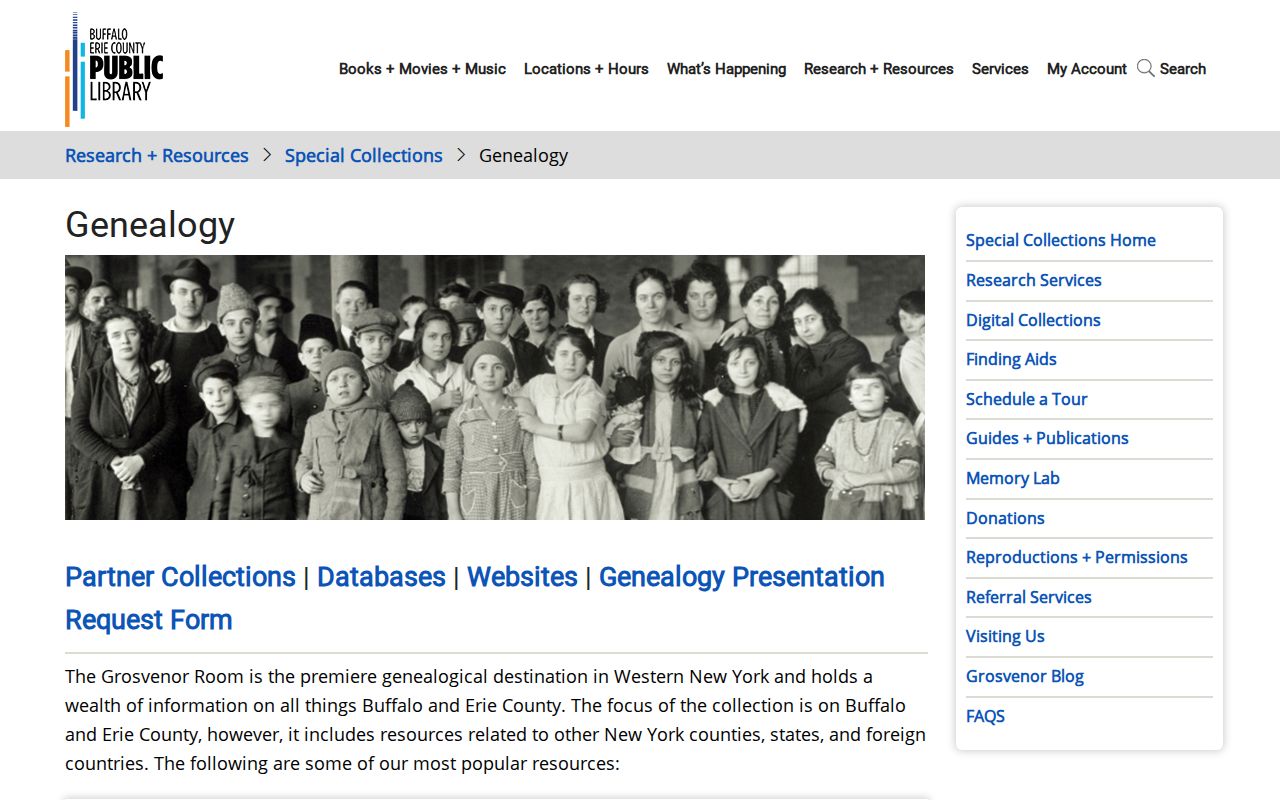
The Grosvenor Room reaches well beyond city directories. Its genealogy resources include newspapers on microfilm, maps, state vital-record microfiche, yearbooks, and 30,000 noncirculating local, family, and military histories. HeritageQuest includes federal census material, city directories, and local-history books. The Local History File is most comprehensive for 1930 to 1982, while the Picture File indexes several school and college yearbooks from the early to mid twentieth century.
See the B&ECPL Grosvenor Room genealogy collection before choosing a research channel.
A catalog or staff inquiry can confirm whether the requested directory, microfilm roll, map, or yearbook is available in the reading room. The West Seneca branch at 1300 Union Road is a useful local contact, but the research shelf should not be assumed to be housed at the branch.
Grosvenor Room research services can generally handle up to five city- or telephone-directory lookups in one transaction, with a stated basic turnaround of roughly three to five days. A supplied year, spelling, and place name make that limited service more useful. Exact-date obituary and death-notice requests may also be possible in small numbers.
Read a West Seneca City Directory Carefully
A city directory entry is a compact published record, not a full household file. Early entries mostly list men's names and addresses. Later issues can add an occupation, an employer, a spouse or widow reference, and an h/r mark for homeowner or renter. Preserve the printed spelling and punctuation. A mark is evidence of what that edition printed, not a title opinion or proof of every person in the household.
| Printed name | Copy the spelling as printed, then note variants separately. |
|---|---|
| Street and address | Record the full address and the city or suburban edition that supplied it. |
| Work line | Occupation or employer, when the directory includes one. |
| Family notation | A spouse, wife, or widow parenthetical can distinguish similar names. |
| h/r notation | A printed homeowner or renter convention, subject to that volume's key. |
| Citation | Directory year, title, page or scan, and the abbreviation key consulted. |
- Criss-cross directory
- An address-ordered section that points from a street address to the person printed there for that edition.
- Householder index
- A name-oriented arrangement that can identify the listed head of a household before an address check.
- Abbreviation key
- The volume's explanation of short forms, which should be read before interpreting h/r or occupation shorthand.
Do not publish an invented example entry. The digitized 1917 Farm Journal volume and the library guide were inspected, but no individual West Seneca entry was safely transcribed in the research. A real transcription needs the actual page, the printed wording, and its scan citation.
West Seneca Directory Years in Context
Choosing a source by era prevents a misleading search. The library's West Seneca cross-reference moves from an 1870 Buffalo/Erie County Register and farmer directory to a 1917 Erie County directory, a 1949 suburban directory, named 1960s and 1970s suburban runs, and countywide Haines address directories from 1968. These are different published tools with different geographic reach.
| Period | West Seneca research lead | Important limitation |
|---|---|---|
| 1870 | Buffalo/Erie County Register and farmer directory | A countywide lead, not proof of universal town coverage. |
| 1917 | Farm Journal Illustrated Rural Directory of Erie County | Read the actual page before treating a name as a listing. |
| 1926 to 1971 | Town-arranged Erie voter-registration directories | Dated historical material, not a current roster. |
| 1968 forward | Haines Directory for all Erie County | Confirm the right edition and its address coverage. |
The Buffalo City Directories collection on New York Heritage supplies the digitized 1832 to 1913 run.
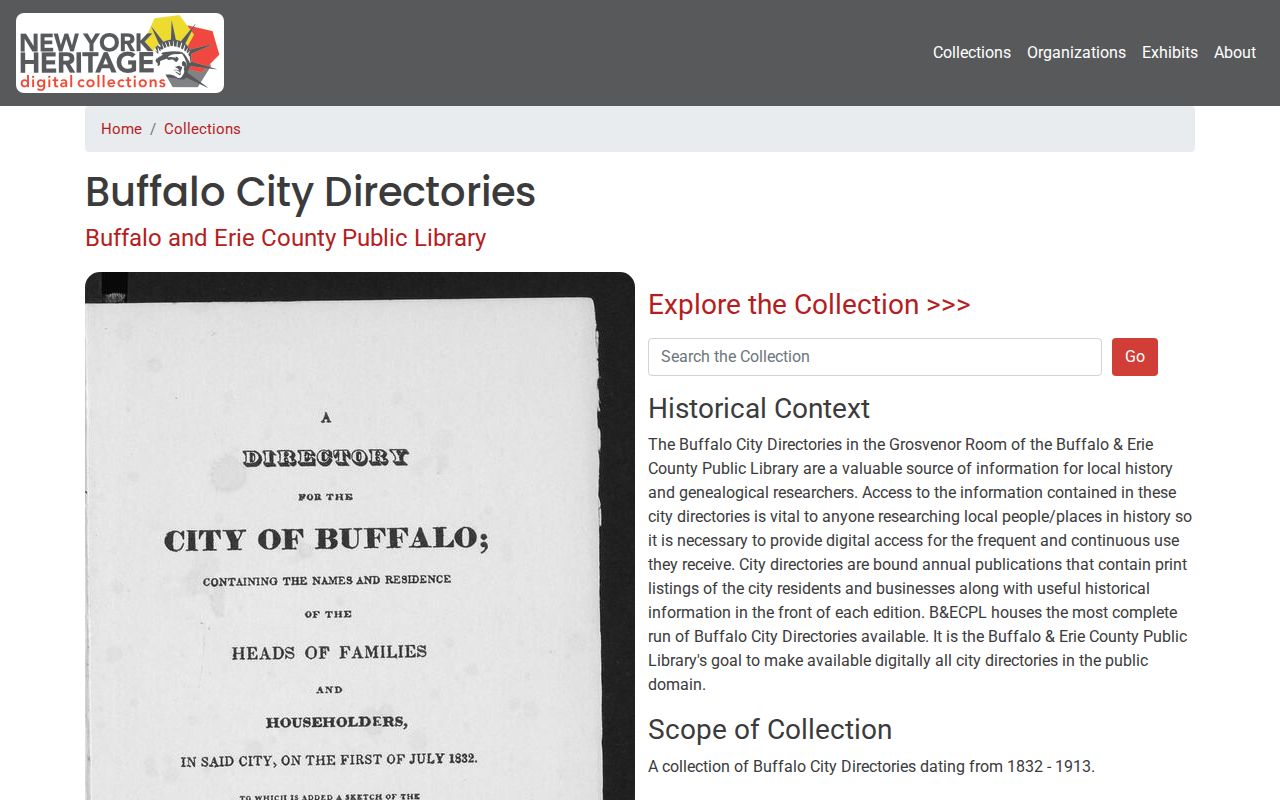
The collection has 77 objects and supports browsing within its annual bound publications. It is especially useful for identifying a regional volume, while the physical Grosvenor Room shelf fills later and suburban gaps.
West Seneca's Ebenezer Directory Clues
West Seneca's older locality terms can make an ordinary directory search unexpectedly narrow. More than 800 German Lutheran settlers arrived between 1843 and 1845 for the Community of True Inspiration, also called the Ebenezer Society. The Town identifies Middle, Upper, Lower, and New Ebenezer, with later ties to Gardenville and Blossom. Retain a source's spelling rather than replacing it with a modern label.
The Town Historical Museum offers a documented illustration of how local place and family history can reinforce a printed listing. Its Lower Ebenezer Society house stood originally at 623 Main Street, moved to 919 Mill Road in 1956, and has a Town-sourced succession of named occupants. That is a model for careful documentation, not a reason to infer a similar story for another house.
Visit the Town Historical Museum record for the source context.
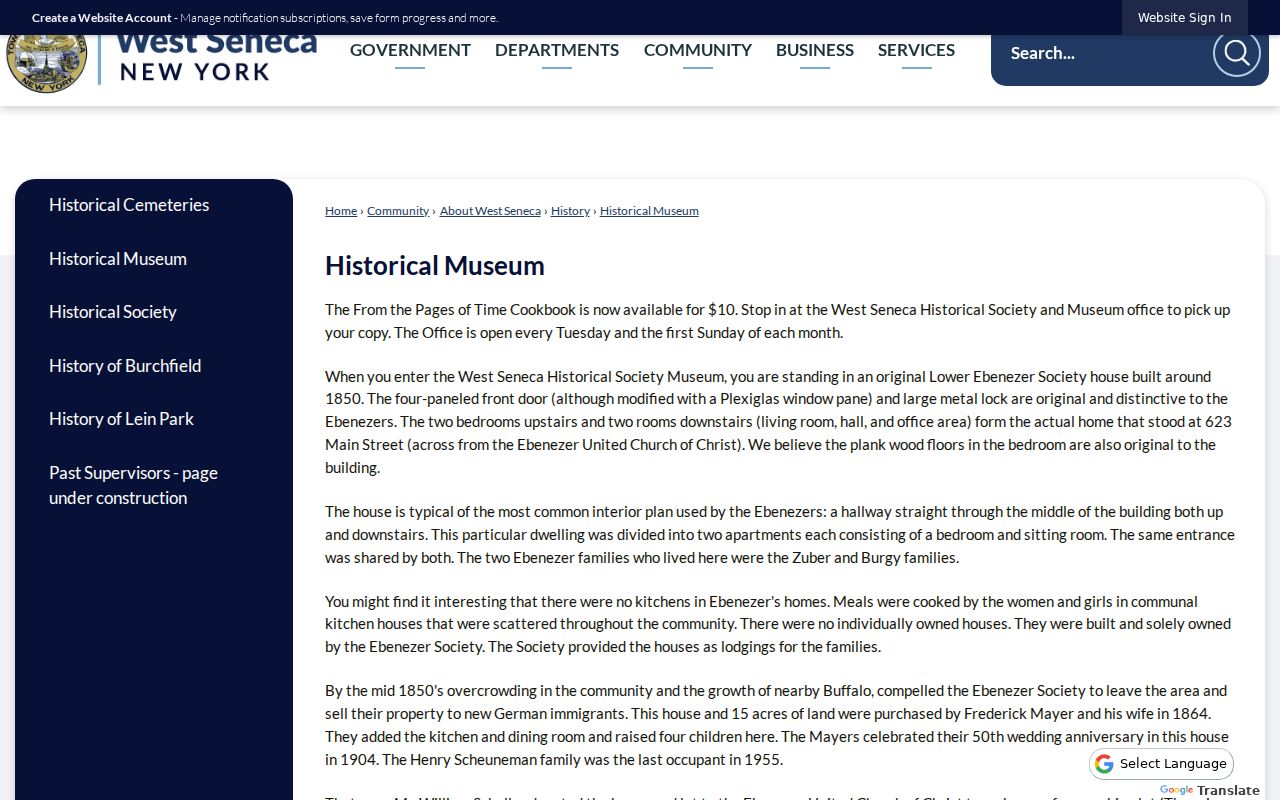
When an address is associated with a hamlet or an Ebenezer family, combine the directory citation with a deed, map, parish or cemetery source before reaching a conclusion.
The West Seneca Historical Society, founded in 1946, maintains a museum at 919 Mill Road and connects researchers with the Town Historian.
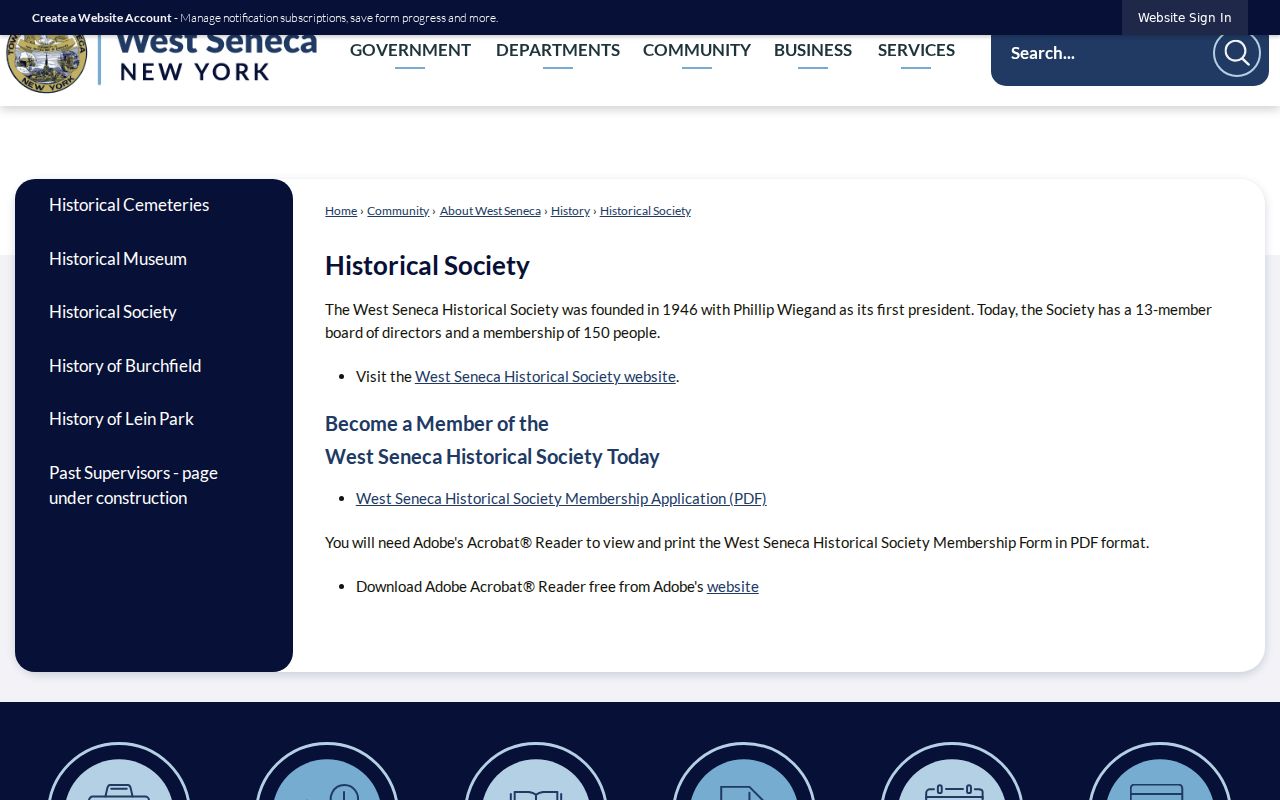
Its historic-house, cemetery, and Ebenezer materials provide local context, but it does not publish a general list of members or former residents.
Trace West Seneca City Directory Households
Follow a household through more than one edition. Start with the best-known surname and address in a title that covers West Seneca for the target period. Record every move, occupation line, spouse or widow marker, and printed locality. Then use the address section or a relevant Haines volume to test whether the same address carried another listed person before or after the entry.
- Find the surname in a geographically appropriate directory and save the year, page, and printed spelling.
- Check adjacent years for address changes, occupation changes, and family notations.
- Use the right address or criss-cross section to identify the prior or next listed person at that address.
- Compare the interval with a recorded deed date and legal description instead of assuming a move date.
- Pair the interval with a census, newspaper notice, cemetery guide, or probate record to test the household connection.
Federal census schedules give snapshots rather than annual listings. B&ECPL resources include federal census access through HeritageQuest, with 1950 released by NARA in 2022. Newspaper microfilm can help close a gap: the Grosvenor Room holds Buffalo News from 1881 forward and Courier Express from 1926 to 1982, among other local titles.
For a family name discovered in an older volume, the West Seneca resident lookup route can help distinguish a historic directory lead from a modern record held by a different custodian.
West Seneca Directory Access Options
There is more than one access channel when a digital browse does not answer the question. Begin online with New York Heritage for the 1832 to 1913 Buffalo collection. For later Buffalo, suburban, Haines, map, and microfilm material, use the Grosvenor Room catalog and reading room. A limited remote request can be practical when a year and name are already known. For a town-specific question about historical context, the Historical Society, Town Historian, museum, or Town Clerk's genealogical-search channel may supply a more fitting local lead.
Library and archive material should be cited as historical evidence with its year and source. A city directory can establish that a name was printed in a particular publication. It cannot, by itself, establish legal ownership, every household member, or a present-day connection.
Note: Keep a search log with the directory title, date checked, locality terms, page reference, and any gap or negative result.